
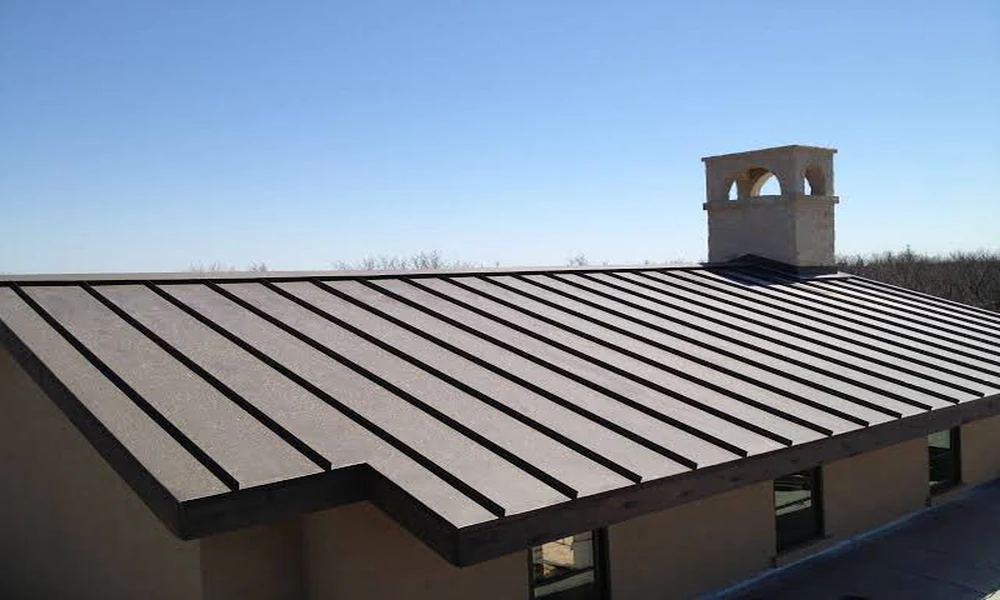

Drive the back roads between Marble Falls and Kingsland and you start noticing metal roofs on almost every other property. Some have crisp vertical ribs with nothing interrupting the panel. Others show neat rows of small dots marching across the slope, and every one of those dots is a screw. From the road they both read as a metal roof, but they are built in completely different ways, and the gap between them grows wider with every summer they spend under the Texas sun.
Homeowners around the Highland Lakes who want a closer look at that difference can turn to Ridgely Roofing, a locally owned Marble Falls outfit whose crews install standing seam metal alongside asphalt shingle and composition roofs. The team brings 34 years of experience to repairs on every roof type, adds 5 inch and 6 inch K style gutters where a house needs them, and helps with insurance paperwork when a storm claim is part of the job. Repair calls like those put a crew on metal roofs at every stage of life, which is exactly where the contrast below shows up.
Where the Screws Show and Where They Hide
A screw down roof, often called an exposed fastener roof, uses panels such as R panel or PBR that overlap at their edges. Screws pass straight through the face of the metal into the deck or purlins below, and each one carries a small rubber washer that does the real work of keeping water out. It is a simple system, quick to install, and it has covered Texas barns and ranch houses for generations.
A standing seam roof turns that idea inside out. Each panel runs in one piece from ridge to eave with raised legs on both sides. Hidden clips fasten those legs to the deck, and the next panel locks over them, either by snapping into place or by being crimped shut with a seaming tool. Water running down the slope never meets a hole, because there isn’t one in the flat of the panel.
That single detail, holes in the panel or no holes at all, shapes nearly everything that follows.
The First Summer Proves Almost Nothing
On installation day both roofs look sharp and both keep the rain out. Through the first year or two you would struggle to tell them apart on performance. The finish is bright, the washers are soft and pliable, and every lap sits tight.
What happens out of sight matters more. Metal grows and shrinks with temperature, and a roof surface in the Hill Country can swing well over 100 degrees between a cold January dawn and a July afternoon. A standing seam panel is designed for this. Its clips let the metal slide slightly with each cycle, so the stress has somewhere to go. A screw down panel is pinned in place at hundreds of points, so every expansion tugs against every screw.
Somewhere Past Year Ten the Washers Start Talking
This is the stretch where the two roofs part ways. The rubber washers on a screw down roof sit in direct sun all day, and that exposure slowly hardens and cracks them. Years of thermal movement can also work the screw holes slightly oval, a problem roofers call wallowing, and some screws back out a few threads. None of this arrives as a dramatic failure. It arrives as a brown ring on a bedroom ceiling after a long spring rain.
The fix is routine but real. A crew walks the roof, swaps worn screws for fresh ones (sometimes a size larger so they bite into enlarged holes), and reseals laps and trim where needed. Owners of screw down roofs should expect that kind of visit roughly once a decade for as long as the roof stays up, plus a check after any serious storm.
A standing seam roof of the same age usually asks for far less. Someone should look over the flashing around chimneys, vents and skylights, and clear live oak leaves out of the valleys and gutters. Its weak points sit at the penetrations and edges, not across the open field of the roof.
Hail Leaves Its Mark on Both
Spring storms rolling across Burnet County do not care which panel profile is on top of the house. Large hail can dent either style, and thinner metal dents more easily. Screw down panels are often sold in 29 gauge, while residential standing seam typically runs 26 or 24 gauge, and that extra thickness gives it a real edge when the ice starts falling.
Insurance adds another layer to the decision. The Texas Department of Insurance explains on its impact resistant roofing page that roof coverings tested under UL 2218 can earn premium credits, with a Class 4 rating earning the largest one and the contractor documenting the installation on form PC068. Plenty of metal panels carry a Class 4 rating, but that test measures whether the roof cracks or leaks, not whether it dents. That is why many Texas policies now attach cosmetic damage exclusions to metal roofs, which means a dented but watertight roof may not be paid for after a storm. Reading the policy before picking a panel is worth an evening at the kitchen table.
The Two Roofs Side by Side
| Detail | Screw down (exposed fastener) | Standing seam |
|---|---|---|
| How it is fastened | Screws through the panel face, sealed by rubber washers | Hidden clips beneath the seams |
| Typical residential gauge | 29 or 26 | 26 or 24 |
| Thermal movement | Restrained at every screw | Clips let panels float |
| Lowest practical pitch | Usually around 3 in 12 | Mechanically seamed panels can go much lower |
| Routine upkeep | Screw and washer replacement over time | Flashing checks and debris clearing |
| Adding solar later | Brackets screwed through the ribs | Clamps grip the seams with no new holes |
| Upfront cost | Lower | Noticeably higher |
| Overall look | Rustic and agricultural | Clean and architectural |
Matching the Panel to the Building
Neither roof is the wrong answer everywhere. A hay barn, a workshop, a carport or a pole building out on acreage is the natural home for screw down panels. The structure is simple, nobody sleeps under it, an occasional drip near a screw is a nuisance rather than a ruined ceiling, and the lower price stretches across a lot of square footage.
The main house is a different conversation, especially a weekend place on Lake LBJ or Lake Marble Falls that might sit empty for weeks at a time. A slow leak at a tired washer can soak insulation and drywall long before anyone walks in and notices the smell. Concealed fasteners take that risk off the open roof. Low slope sections, like the porch roofs and back additions found on many older Hill Country homes, also favor mechanically seamed panels, because exposed laps struggle when water moves slowly across them.
Future plans count as well. Solar clamps that grip a standing seam leave the panel untouched, which keeps a later solar project from turning into a leak project. And since metal sheds a hard Texas downpour far faster than shingles do, the gutters below it work harder too. On long eaves, a 6 inch gutter often handles that rush better than the more common 5 inch size.
Finish and underlayment deserve attention on either style. Panels coated with PVDF paint, often sold under the Kynar 500 name, hold their color and resist chalking under intense sun much longer than the cheaper SMP finishes common on budget screw down panels. Beneath the metal, a high temperature synthetic underlayment stands up to deck heat far better than old felt paper ever did.
Pricing the Whole Life of the Roof
On the estimate, a screw down roof almost always wins. Stretch the timeline across thirty or forty years, though, and the picture shifts. Add in a few rounds of fastener replacement, the chance of interior damage from a leak nobody caught, and a possible insurance headache after a dented roof, and the distance between the two prices narrows considerably.
The better choice comes down to what sits under the roof, how long you plan to stay, and how much attention you want to give it. Those two roofs on that same Hill Country road will look nearly identical for the first few years. Twenty summers later, the one with the hidden clips is usually the one nobody has had to think about.
